
« THE FIRST FIRE 1
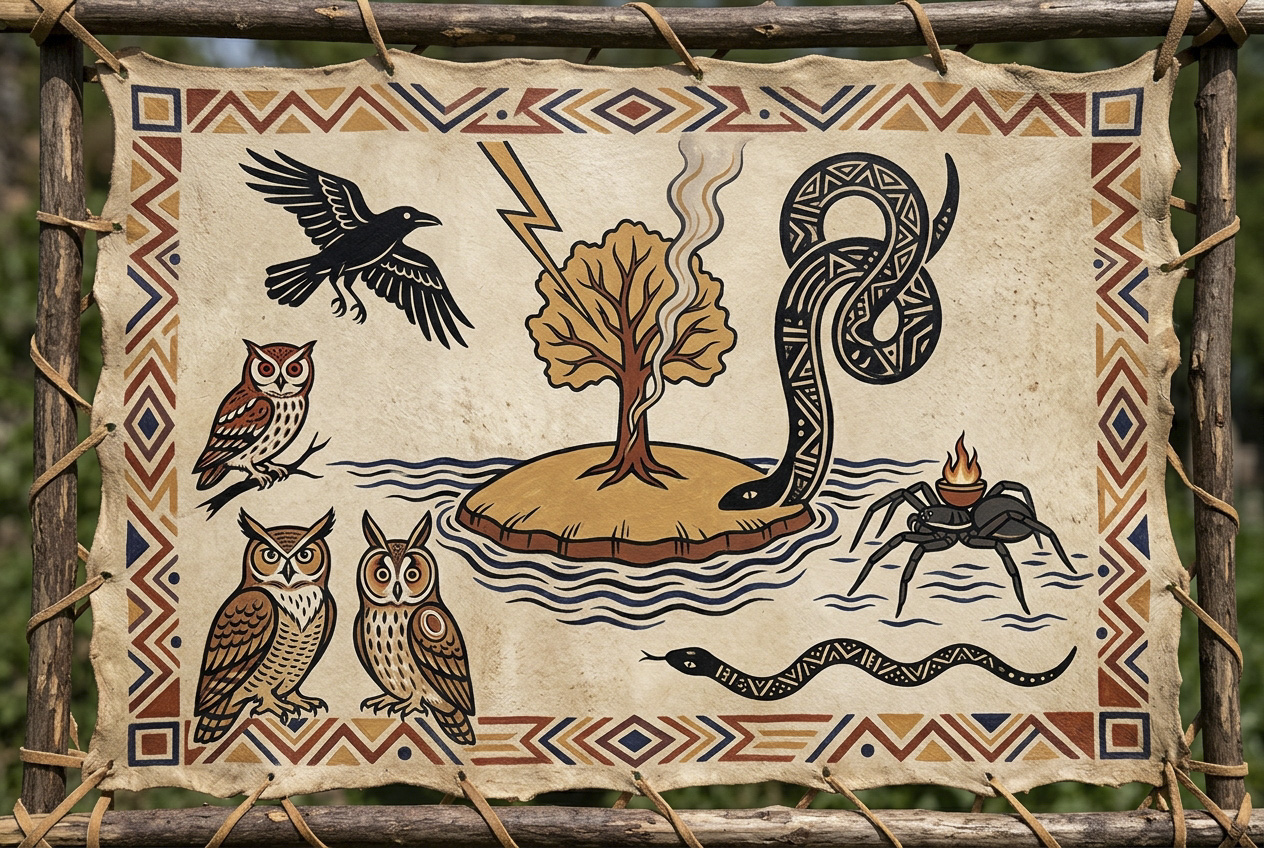
In the beginning there was no fire, and the world was cold, until the Thunders (Ani’-Hyufi’tikwaM’ski), who lived up in Galun’lati, sent their lightning and put fire into the bottom of a hollow sycamore tree which grew on an island. The animals knew it was there, because they could see the smoke coming out at the top, but they could not get to it on account of the water, so they held a council to decide what to do. This was a long time ago. Every animal that could fly or swim was anxious to go after the fire. The Raven offered, and because he was so large and strong they thought he could surely do the work, so he was sent first. He flew high and far across the water and alighted on the sycamore tree, but while he was wondering what to do next, the heat had scorched all his feathers black, and he was frightened and came back without the fire. The little Screech-owl ( Wa’huhu’) volunteered to go, and reached the place safely, but while he was looking down into the hollow tree a blast of hot air came up and nearly burned out his eyes. He managed to fly home as best he could, but it was a long time before he could see well, and his eyes are red to this day. Then the Hooting Owl ( U’guku’) and the Horned Owl (Tskili’) went, but by the time they got to the hollow tree the fire was burning so fiercely that the smoke nearly blinded them, and the ashes carried up by the wind made white rings about their eyes. They had to come home again without the fire, but with all their rubbing they were never able to get rid of the white rings. Now no more of the birds would venture, and so the little Uksu’hi snake, the black racer, said he would go through the water and bring back some fire. He swam across to the island and crawled through the grass to the tree, and went in by a small hole at the bottom. The heat and smoke were too much for him, too, and after dodging about blindly over the hot ashes until he was almost on fire himself he man- aged by good luck to get out again at the same hole, but his body had been scorched black, and he has ever since had the habit of darting and doubling on his track as if trying to escape from close quarters. He came back, and the great blacksnake, Gule’gi, “The Climber,” offered to go for fire. He swam over to the island and climbed up the tree on the outside, as the blacksnake always does, but when he put his head down into the hole the smoke choked him so that he fell into the burning stump, and before he could climb out again he was as black as the Uksu’hi. Now they held another council, for still there was no fire, and the world was cold, but birds, snakes, and four-footed animals, all had some excuse for not going, because they were all afraid to venture near the burning sycamore, until at last Kanane’ski Amai’yehi (the Water Spider) said she would go. This is not the water spider that looks like a mosquito, but the other one, with black downy hair and red stripes on her body. She can run on top of the water or dive to the bottom, so there would be no trouble to get over to the island, but the question was, How could she bring back the fire? “I’ll manage that,” said the Water Spider; so she spun a thread from her body and wove it into a Utsti bowl, which she fastened on her back. Then she crossed over to the island and through the grass to where the fire was still burning. She put one little coal of fire into her bowl, and came back with it, and ever since we have had fire, and the Water Spider still keeps her tusti bowl. »
IL PRIMO FUOCO
In principio non c’era il fuoco e il mondo era freddo, finché i Tuoni (Ani’-Hyufi’tikwaM’ski), che vivevano lassù in Galun’lati, mandarono i loro fulmini e posero il fuoco nel fondo del tronco cavo di un sicomoro che cresceva su un’isola. Gli animali sapevano che il fuoco era lì, perché potevano vedere il fumo uscire dalla cima, ma non potevano raggiungerlo a causa dell’acqua; cosicché tennero un consiglio per decidere il da farsi. Questo accadde molto tempo fa.
Ogni animale che sapesse volare o nuotare desiderava ardentemente andare a prendere il fuoco. Il Corvo si offrì per primo e, poiché era così grande e forte, pensarono che avrebbe sicuramente portato a termine l’impresa, perciò fu mandato per primo. Volò in alto e lontano attraverso l’acqua e si posò sul sicomoro; ma mentre si chiedeva cosa fare dopo, il calore gli bruciacchiò tutte le piume facendole diventare nere, ed egli si spaventò e tornò indietro senza il fuoco.
Il piccolo Assiolo (Wa’huhu’) si offrì volontario per andare e raggiunse il luogo sano e salvo; ma mentre guardava dentro l’albero cavo, una zaffata d’aria calda salì verso l’alto e quasi gli bruciò gli occhi. Riuscì a volare a casa meglio che poté, ma passò molto tempo prima che potesse vederci bene, e i suoi occhi sono rossi ancora oggi.
Poi andarono il Gufo comune (U’guku’) e il Gufo reale (Tskili’); ma quando arrivarono all’albero cavo, il fuoco bruciava così violentemente che il fumo quasi li accecò, e le ceneri sollevate dal vento formarono degli anelli bianchi attorno ai loro occhi. Dovettero tornare a casa di nuovo senza il fuoco e, per quanto si strofinassero, non riuscirono mai più a sbarazzarsi di quegli anelli bianchi.
A quel punto nessun altro uccello volle rischiare, e così il piccolo serpente Uksu’hi, il biacco nero, disse che sarebbe passato attraverso l’acqua per riportare un po’ di fuoco. Nuotò fino all’isola, strisciò tra l’erba verso l’albero ed entrò da un piccolo foro alla base. Il calore e il fumo furono troppi anche per lui e, dopo aver schivato ciecamente le ceneri calde fino a rischiare di prendere fuoco egli stesso, riuscì per buona sorte a uscire di nuovo dallo stesso foro; ma il suo corpo era stato bruciato e reso nero, e da allora ha l’abitudine di scattare e ripiegarsi sulle proprie tracce come se cercasse di sfuggire da uno spazio ristretto.
Tornò indietro, e il grande serpente nero Gule’gi, “L’Arrampicatore”, si offrì di andare a prendere il fuoco. Nuotò verso l’isola e si arrampicò sull’albero dall’esterno, come fa sempre il serpente nero; ma quando sporse la testa nel foro, il fumo lo soffocò a tal punto che cadde nel tronco in fiamme e, prima di riuscire ad arrampicarsi di nuovo fuori, era diventato nero come l’Uksu’hi.
Tennero quindi un altro consiglio, perché ancora non c’era il fuoco e il mondo era freddo; ma gli uccelli, i serpenti e gli animali a quattro zampe avevano tutti una scusa per non andare, poiché avevano tutti paura di avventurarsi vicino al sicomoro in fiamme, finché alla fine Kanane’ski Amai’yehi (il Ragno d’Acqua2) disse che ci sarebbe andata lei. Non si tratta del ragno d’acqua che sembra una zanzara, ma dell’altro, quello con la peluria nera e strisce rosse sul corpo. Può correre sulla superficie dell’acqua o tuffarsi fino al fondo, quindi non ci sarebbe stato alcun problema a raggiungere l’isola; ma la domanda era: come avrebbe fatto a riportare indietro il fuoco?
«Ci penserò io», disse il Ragno d’Acqua; così filò un filo dal suo corpo e lo intrecciò in una ciotola tusti, che si fissò sulla schiena. Poi attraversò l’acqua fino all’isola, passò tra l’erba fino al punto in cui il fuoco stava ancora bruciando, mise un piccolo tizzone acceso nella sua ciotola e tornò indietro. Da allora abbiamo il fuoco, e il Ragno d’Acqua conserva ancora la sua ciotola tusti. 3
Bibliografia:
Mooney, James (1902), «The First Fire» (Mito n. 2), in Myths of the Cherokee, Washington, Government Printing Office, pp. 240–242. Disponibile su Internet Archive:
https://archive.org/details/cu31924104080076).
Note:
1.
J. Mooney, The First Fire, in Id., Myths of the Cherokee, Washington, Government Printing Office, 1902, pp. 240–242.
Il testo appartiene alla categoria dei miti eziologici/cosmogonici dei Cherokee (ovvero le storie che spiegano la nascita del mondo, la spiegazione dei tratti fisici degli animali o l’origine degli elementi primordiali come il fuoco e il tabacco). ↩
2.
Il ragno che cammina o corre sulla superficie dell’acqua appartiene spesso al genere Dolomedes, grandi ragni pescatori capaci di muoversi a pelo d’acqua sfruttando la tensione superficiale. A volte si confondono con i gerridi, che però sono insetti noti come “pattinatori d’acqua”, o con il ragno palombaro, che vive invece totalmente sott’acqua. I ragni del genere Dolomedes sono famosi per la loro abilità di muoversi sopra i laghi, gli stagni e i fiumi a corso lento. Come fanno: Usano le zampe larghe e pelose per distribuire il peso. Sfruttano la tensione superficiale dell’acqua senza affondare. Cosa mangiano: Sentono le vibrazioni nell’acqua provocate da piccoli pesci, girini o insetti. Catturano le prede correndo sulla superficie. Dove vivono: Preferiscono zone umide, rive di fiumi e stagni con molta vegetazione.
↩
3.
Traduzione italiana adattata da output dell’IA Google Gemini, basata sul testo originale di J. Mooney (1902). ↩
PUBLISHER
- A cura di: Andrea per mensiva.it
- Stato del testo di partenza: Pubblico Dominio (liberamente riutilizzabile)
- Immagine di copertina: Immagine di fantasia, non reale, realizzata a partire da un prompt scritto per Nano Banana 2 da Andrea - mensiva.it